I.
Habits and Habitudes:
My grandmother Jeanette London Gershon was an accomplished chess player. But her greatest skill at that board was in teaching it, teaching those like me—a five- or six-year-old, the intricacies of rook and pawn, Queen and King. She traditionally would have a prepared chess board in her home, pieces ready for one to open a first, challenging gambit.
Jeanette was an accomplished cook. She kept a Kosher home. Meat was purchased strictly from Atlanta’s several Kosher tradesmen. She made rolled cabbage (with meat and raisins), blintzes, and on Chanukah crisp latkes from a straight-forward recipe of grated potato, egg, salt, and pepper. Traveling with her husband Sam, they stayed almost exclusively within those famed locales comfortable for the Kosher-observant within Southern Jewry. There was, for example, Hendersonville, North Carolina. Hendersonville was in the mountains, where the elevation and breeze would take a bit of sting out of the blazing American summers (in those days before Air-Conditioning). Still home to several Jewish-oriented summer camps, Hendersonville had multiple Kosher Boarding Houses. (I remember as a kid hearing about Mrs. Fleishner’s in particular, though their primary location may have been Atlanta itself). In later years, as the era faded, Linda and I and our kids stayed at Reuben’s Osceola Lodge in that area, our own Southern Catskills food and water escape). Hot Springs, Arkansas, with its healing waters, was another favored visiting site for Jews of the South.
If a bit more vacation time was allowed, there was the drive to Miami Beach. There on Lincoln Road were all the characters: the Deli’s (Wolfie’s, Junior’s, and later The Rascal House); kibbitzing; the Kosher meals available through the Raleigh Hotel, set on South Beach, or on occasion staying at the Versailles Hotel, which described itself as “On the Ocean at 34th & 35th Streets”.
At least once, not able to extend a car trip for the full 800+ miles and three days or so of travel that the pre-Interstate roads demanded, their Buick would route Sam and Jeanette, often with children and grandchildren in toe, to the Atlantic coast of upper Florida: Jacksonville Beach, or even incongruously enough, the hot-rod filled sands of Daytona’s shoreline. Sam, mostly ‘lost’ among the overwhelmingly ‘goyish’ crowds there, sheepishly might side up to a likely/even a possible coreligionist and ask in his best native Yiddish accent: “Du Bista Yid?” (“Are you a Yid, a Jew?”). The story may be apocryphal, but I am told that he once misunderstood a waiter who answered Sam’s question: “Do you have any Jews?” with an almost Non sequitur response: “Yes, we have Orange Juice, Tomato, Pineapple, Prune…”
At least once, the Gershons drove the Buick to St. Louis. I think it verifiable via my siblings and/or older cousins, that they brought back from there in Missouri, swimming in a make-shift tub of water set just under the back seat-bench of their car, two or three fresh, Kosher breeds of live fish—ready for preparation and de-boning once back home.
II.
The Carrolltownier-Rebbetzin:
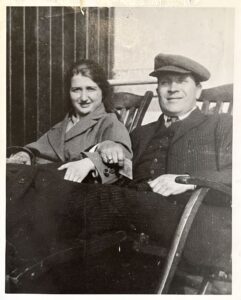
My grandparents showed a loving, mutually respectful relationship. For Sam, he often referred endearingly to his wife Jeanette as “the Rebbetzin.” He could be known to defer to her judgements, knowledge, upbringing, what they call in Jewish “sechel” (a sort of common-sense wisdom). Sam, after all, had curtailed much of his formal, intensely overseen Jewish learning, when still a teenager. Sam engaged himself fully into a successful escaping of the Pale. His education would now be the open road, the scramble for existing in an often-hostile, open environment. Sam would need to master a new language, fine points of business, the very rhythms of a strange and in ways exotic place. (I. J. Schwartz’ 1925 poem “Kentucky” captures some of this transferred complexity of a Lithuanian Jew of that time period suddenly finding himself in the American South). What was to be expected in the American South of the early 20th century? The overwhelming event for the Jews of the region was the lynching of the Jew Leo Frank, local B’nai B’rith chapter president, who on August 17, 1915 was murdered, after having been pulled from a jail cell by a mob. This act was perpetrated by what proved to be many of the most prominent citizens of Marietta, Georgia. (None were ever convicted of the crime). What the Goldstein family was with their grand department store on the square in Cobb County’s Marietta, Mr. Gershon’s The Leader was the very equivalent less than two hours westward, located on Adamson Square in the county seat of Carroll, town of Carrolltown.
Seders at the Gershon home were great affairs. With invited relatives, the meals soon outgrew the oval setting under the wallpaper scene depicting a fictionalized port of Naples in antiquity. Soon, the serving tables would snake through the living room edging even onto the cushioned TV area.
Jeanette years later would be given an honorary plaque, which included on it her beautiful, youthful portrait. There was Sheindle London Gershon, accompanied by those words from the Book of Proverbs known as Eishet Chayil.
Source: https://carrolltonga.com/
III.
The Pesach Madrigal:
For “Ehad Mi Yodeha?” (“Who Knows One?”), the exuberant number madrigal included among those closing songs of the Passover Seder, a unique occurrence can be tied to Jeanette Gershon. The last place on Earth where it is chanted responsively in the tune derived originating from Brest-Litovsk, is to be found in the basement of 1441 Mile Post Drive, Dunwoody. Here, a rich preservationist’s melody has been extended, through at least one more generation. This special rendition, a singsong to be heard nearing the end of those long, gently inebriated evenings of the traditional four cups of wine, is genetically familiar to the progeny of Jeanette Gershon- her children, grandchildren, even great-grandchildren; held tightly in Dunwoody by those clans: Gershon, Beeber, Smith, Arnold.
Brest-Litovsk may have its own notoriety as the place of a Peace Treaty on March 3, 1918, between Soviet Russia and the Central Powers, but in Jewish history it was also once very well known as the renowned site of the Brisker method, an intensive approach for the study of Talmud. Using both long-established traditional methods and honored past sages and commentators from the ages, combined with latest studies and advances of modern sciences such as Astronomy and Linguistics, the Brisker method of Talmud was admired, attempted at replication, in many parts of the Jewish world of that time. The learned and esteemed Soloveitchik family based in Brest-Litovsk were among those at the very center.
Over the generations, that family who would come to be so important in nurturing Judaism in greater Boston and valued also for a good part of the sterling academic reputation of Yeshiva University’s Elchanan Theological Seminary located in upper Manhattan. Scholarship was made an overarching goal. In fact, the name for ‘Brest-Litovsk’ often synonymously was simply said as ‘Brisk’ by fellow Jews, reflecting of the Brisker method of Talmud study.
Brest-Litovsk, local non-Jewish population often simply calling it Brest, retained in certain Jewish lore a critical suffix- that reference of ‘Litvak’. That is to say, in history there had been at one time an extensive Kingdom of Lithuania. As I understand it, as its borders retreated over time, a small territorial pocket was left behind and essentially encircled. Ultimately a relatively isolated city (Brest-Litovsk) became distanced from the geographic home base of Vilna (Lithuania) which itself was famed for learning and even titled at one point “the Jerusalem of Europe”. ‘Brest-Litovsk’ was the ‘Brest of the Litvaks’. It was a site of great intellectual Jewish tradition, a lively border zone which included a mix of colorful Jewish evolutions, variations including both Misnagdim and Hasidim ‘minhagim’ [religious customs] for example.
IV.
Sam Gershon, Southern Delegate to the Kobriner Relief Association:
Sam Gershon, as Southern delegate to the Kobriner Relief Association, was chosen to safeguard the transfer of funds gathered in America back to the impoverished Jews of their hometown area, Kobrin. At today’s (c. 2025) exchange rate, it is estimated that he was entrusted with over $2 million dollars in such donated funds. Armed guarding of that amount of money occurred. The two trips to Europe on behalf of this group were covered with articles in main citywide newspaper, “The Atlanta Constitution.”
Sam had become a successful businessman. He was just under forty-four years old, still able to manage the physical demands of such travel to Eastern Europe. As “Southern Delegate”, likely Sam would have made ‘rounds’, visits, in those towns associated with the scattered Jewish, formerly ‘Kobriner’ citizenry. These sites would have included Knoxville (TN), Pensacola (FL), and Birmingham (AL). While many ‘landsmen’ also had settled around Baltimore (MD), given the size and importance of that town it likely had its own assigned separate delegate.
What is known of this Kobriner Relief Association? The YIVO Institute for Jewish Reseach is located at 15 West 16th Street in Manhattan. YIVO describes itself as the “Archives and Library [which] represent the single largest and most comprehensive collection of material on East Europe Jewish civilization in the world.” A telephone call to YIVO, revealed that in fact their archives had a file on the Kobriner Relief Association! Airplane to New York; in the Archives Room; the tray arrives, with the requisite white gloves for handling the historic papers. Is this it? Is this the key to understanding “the Southern delegate”? The material, while extensive, concerned only ‘northern’ members of the group, moreover, dated back only to the early 1950s. (Included however was a long list of dues-paying members, along with their telephone numbers, dating from seventy years ago. Could a sleuth gumshoe their way to reaching these individuals or their descendants, acquiring the sought for information? If it is to be, that is the role of a later family genealogist).
(Indeed, a paper is being developed to be presented to the Southern Jewish Historical Society, discussing Sam Gershon and his role as the Southern Delegate for the Kobriner Relief Association).
Note Sam Gershon seated second from right.
V.
Sam Gershon’s business ascent:
As told to me by my Aunt Phyllis Arnold and corroborated by my mother, Elaine Gershon Beeber, Sam’s successful career began with that most inconspicuous and perhaps quintessential of Jewish initiation tales, setting out as a peddler with a pack on his back. Sam would ride the Atlanta trolley car as far as it would go. Then, he would walk, walk, walk. Finally, when arriving in far-reaches untouched by other such similar entrepreneurs he would begin showing his wares. He spent some nights as a guest being allowed to sleep in barns. With time, Sam took steps forward- traveling by horse, then horse and buggy, and finally the crowning achievement of a standing store. At its height, The Leader Department Store chain could be found selling ‘dry goods’ in over a dozen Georgia cities. Store locations included McRae, Hawkinsville, Calhoun, Cornelia, Gainesville, Tallapoosa, and of course the heart of the ‘empire’, Carrolltown. The furthest reaches may have been southward to the town of Fitzgerald, in Ben Hill County, northward to Toccoa, westward to Heflin, Alabama (possibly). Only the Great Depression would dampen the business success of Sam Gershon, compounded with his long periods away from the work site in his volunteerism for Kobriner Relief, as well as the advancing of his own years, a growing number of children in the household, and wide expenses of bringing over nearly two dozen souls from Poland (now mostly sites in Belarus), while too vouching for their economic viability in America, often including bailing out one or another from failing business ventures or straining medical expenses.
In later years, remembering his own beginnings, the Gershon house in Carrolltown, Georgia, was a welcome respite for many a Jewish traveling salesman, working the circuit of their clientele about the little towns and cities of the South. At the Gershon house there would be a clean and safe bedding, kosher food, and at night if interested in companionship, a Gin Rummy game could be organized for interaction with the other Jews of this mostly rural community.
VI.
Sam meets Jeanette:
The first community found on a map traveling eastward from Brest in Belarus is Kobrin. The distance is just under 49 kilometers (~30 miles). Driving between Brest and Kobrin is estimated to take 44 minutes on the E 30 roadway. Twice daily bus service also links these two communities, and rail lines too still exist which connect them. In the early 1920s, Sam Gershon was serving as Southern Delegate to the Kobriner Relief Association, making extended visits in which ‘tzedekah’ gathered from those who may have immigrated to the United States and other countries, would send money “back to the Old Country.” While a
range of economic experience existed in Poland, a sizable number of the Jewish population in Kobrin lived in grinding poverty. Distribution of those funds from America would be given especially to the local Jewish Orphanage, as well serving as seed-money to help support a sewing factory of sorts, where especially Jewish women of the region could make clothing and other such materials that might be sold to help generate additional financial stability even locally. Sam was a delegate to his former hometown, his father still living there. Sam Gershon presented a distinguished appearance, in silk top hat and fine leather shoes. While at the work of safely bringing the collected monies to the sites of need, Sam was thunderstruck by a chance encounter with Jeanette London, fifth of the eighth children of Brest-Litovsk ‘balabos’ Chaim Shachnah London and his wife Yohevet Dworetsky. Sam hoped to somehow meet her. But how, how would he properly introduce himself to the young woman, so beautiful herself that she was called by the Yiddish name Sheindle? Sam’s choice: “I’ll invite her to the Opera” he thought. Naturally, that would involve three tickets, since Sheindle would be expected to have and even require a family chaperone, if she were to be allowed to socialize in any fashion with this visiting American! Sam himself was a great lover of music, enjoying the waltzes of the Strausses and other composers. He had played coronet in an army band of the Tzar. His brother Oscar would write an opera (unpublished) himself, as well as spend time in Germany studying to train his voice to be a Hazan, until war intervened and changed his future. Our hero from the “Golden Medina”, the Golden Land of America, what did he do? Well, it seemed that he actually had not three opera tickets, not two, actually not even one. But be sure once Sheindle agreed to go with him to the performance, Sam magically made sure that he obtained the needed entry and that his ruse would never be uncovered.
Coda: Chaim Shachnah and his wife Yochevet were unsure. There was the age difference (Sam being at least twenty years Jeanette’s senior). There was the fact that they would move back to Sam’s home in America, a place called Georgia, and it was unclear as such if the parents would ever again see their beloved daughter. -This fear proved well founded, for with the onset of war and Holocaust, the family never after was given the setting for regathering. The Gershon-London wedding would be a one such occasion. With time, persistence, consistency, love, manners, and no small amount of mazel, the odd ‘besherit’ nature of this travel from Carrollton to Brest-Litovsk would engender a nearly 50-year marriage, one which produced four living children and over a dozen grandchildren.
VII.
Why we are where we are?
What quirk of history dropped us to where we are today? What manipulation in the Heavens set our course to be at this moment? How is it that within about two decades of arriving, Sam Gershon was a Southern Delegate of the Kobriner Relief Association”
As my late wife Leba bat Yeheil (Linda) liked to summarize: “what is besherit is besherit.” But, I am in Atlanta, Georgia, USA. Why?
This story was related to me by the late-Mendel Rohm, a cousin and as I discovered right at the tail end of his life, a valuable family historian. Cousin Mendel in his Atlanta apartment told me the following story.
As a teenager, Sam Gershon (then Shlomi Zalman ben Betzelel) wanted to leave Europe, a story familiar yet always a bit uniquely personal for so many of the Jewish youth growing up in the Pale, the so-called Pale of Settlement. Sam and a good friend [Anita Levy’s father, Mr. Epstein] struck out together. They reached the Elbe River site of the Hamburg-Amerika Shipping Line. They were in London, England, for the Diamond Jubilee celebration of the 75th year of the reign of Queen Victoria. They arrived in the US via Ellis Island and spent a few months about New York City.
The city of Birmingham, Alabama had been founded in 1871. It was a boom town, a steel town graced with extensive local deposits of iron and coal, and ample waterways to stir the needs of industry. Birmingham was a like a new Pittsburgh; Birmingham (Alabama), in a very real sense, was like a new Birmingham (England). Everything industrial could find a ready market and growth of the area was exploding with opportunity and work. The Weinsteins, brothers tracing to Kobrin, had settled in Birmingham. They were cousins of Sam Gershon, on his mother’s side. [ed.: Sam’s mother herself may have been a Weinstein or married to one]. Their family legacy in Kobrin was that of owning and operating a brick-making factory. I suspect the same was planned for Alabama. A young nephew was on his way, having successfully managed to leave Europe. Sam’s first leg of travel was taking the north to south train route out of New York. To connect east to west, there would need to be a change of trains in Atlanta (Georgia). Sam got off the train. He soon met with either direct landsmen or those who had close connections to the family in Kobrin. Sam, but maybe eighteen or nineteen years old himself, was almost immediately meeting the leaders and forward members of the growing Jewish community of Atlanta. One man in particular, the established Mr. Lichtenstein, took a particular interest in the
young traveler. Sam was encouraged by them to stay. The congregation of K. K. Ahavath Achim, soon to be on Gilmer Street, was about a dozen years old. Sam stayed, set roots. He long served as a major organizer of the synagogue’s Purim Spiel, and its annual ‘carnival’. Sam’s activity expanded steadily, including serving the synagogue on its Washington Street Building Committee. Soon, Sam’s role was reinforced with the arrival in Atlanta of his younger brother Oscar. Oscar was brought, plucked, out of the growing maelstrom of Europe, and himself would in the 1930s become a president of the schul. Sam’s foresight, evident with his brother, would be extended to many relatives and close connections, especially from his hometown of Kobrin and that of the community of his wife Jeanette, in Brest-Litovsk. The interventions for those twenty or so souls he helped generated ultimately dozens of individuals and families whose fate would have been otherwise wrapped in the destruction of the Holocaust.
And so, here we are today.
VIII.
CLOSING
There is much more. Legend had the brave, young, steely youth Shlomi Zalman Hershengaus (Sam Gershon) driving a haycart of Jews to be smuggled across a border in Poland to reach the shipyards of Breman and Hanover, in Germany. From there, the sailing to America was freedom and potential opportunity. It is said that the Rothschild family had paid for the dangerous undertaking. Though border-guards struck the packed haystacks with biting pitchforks, none of the Jews who were fleeing were either caught or injured in this ruse.
I am told that my grandmother Jeanette London Gershon had a close connection to all her siblings, and particularly with her slightly younger brother, Max London. Max, a brilliant mind and student, developed too as a talented horseman, a skill that would prove lifesaving in the years around World War I.
Grandmother Jeanette told me of that day she went strolling in the nearby forest of Brest-Litovsk. Suddenly, nailed onto a tree, was a roughly hand-painted wooden sign saying simply, in translation:
“PROKLAMACJA” that is: ‘Proclamation’. War!
And that was how war began, after which existence in Brest-Litovsk, especially for its Jewish citizenry, would never be the same. Life would spill from tragedy to tragedy:
Cossacks, thieves, warfare, destruction, troop placements, hunger, inflation, dispossession, rising fascism, and in the end in culmination with the Shoah, the Holocaust, which would come to destroy the entirety of a Jewish world that had been established there for hundreds of years.
During the 1920s, while a brief window existed in America allowed for legal immigration for many including Jews from Eastern and Central Europe, Sam and Jeanette Gershon would work toward and come to economically sponsor the arrival in America, especially Atlanta, of at least twenty separate relatives and close associates. Included were most of Sam and Jeanette’s siblings, as well as many nieces, more distant cousins, even friends. -Sam would be back in Kobrin at least once in the mid-1930s. Europe was darkening, especially it would turn out, for its Jewish population. Sam had purchased and brought with him a Torah, one to be dedicated at the synagogue of his father, Betzelel Hershengaus. Photographs of that visit show Sam’s father as an infirmed man, carried by men of the community on their shoulders as he laid on a recliner, marching right along with the Torah to its intended destination at the house of worship.
……………………………………………………………………………………………
Submitted by Dr. Bruce Beeber, July, 2025